
The challenge: transforming 500 static pages into an intelligent agent
Onboarding documentation gathers all the crucial information an official needs to perform their tasks. Whether in paper or PDF format, finding a specific answer to complex questions such as “What is the procedure for submitting a motion to the council?” or “Which laws govern municipal jurisdictions?” can be incredibly time‑consuming.
The City of Lévis was looking for a solution to:
- Speed up access to information for both new and returning elected officials.
- Modernize its governance tools.
- Deploy the tool quickly before the newly elected officials take office (4‑week deadline).
The Nmédia solution: Synapse as a partner for elected officials
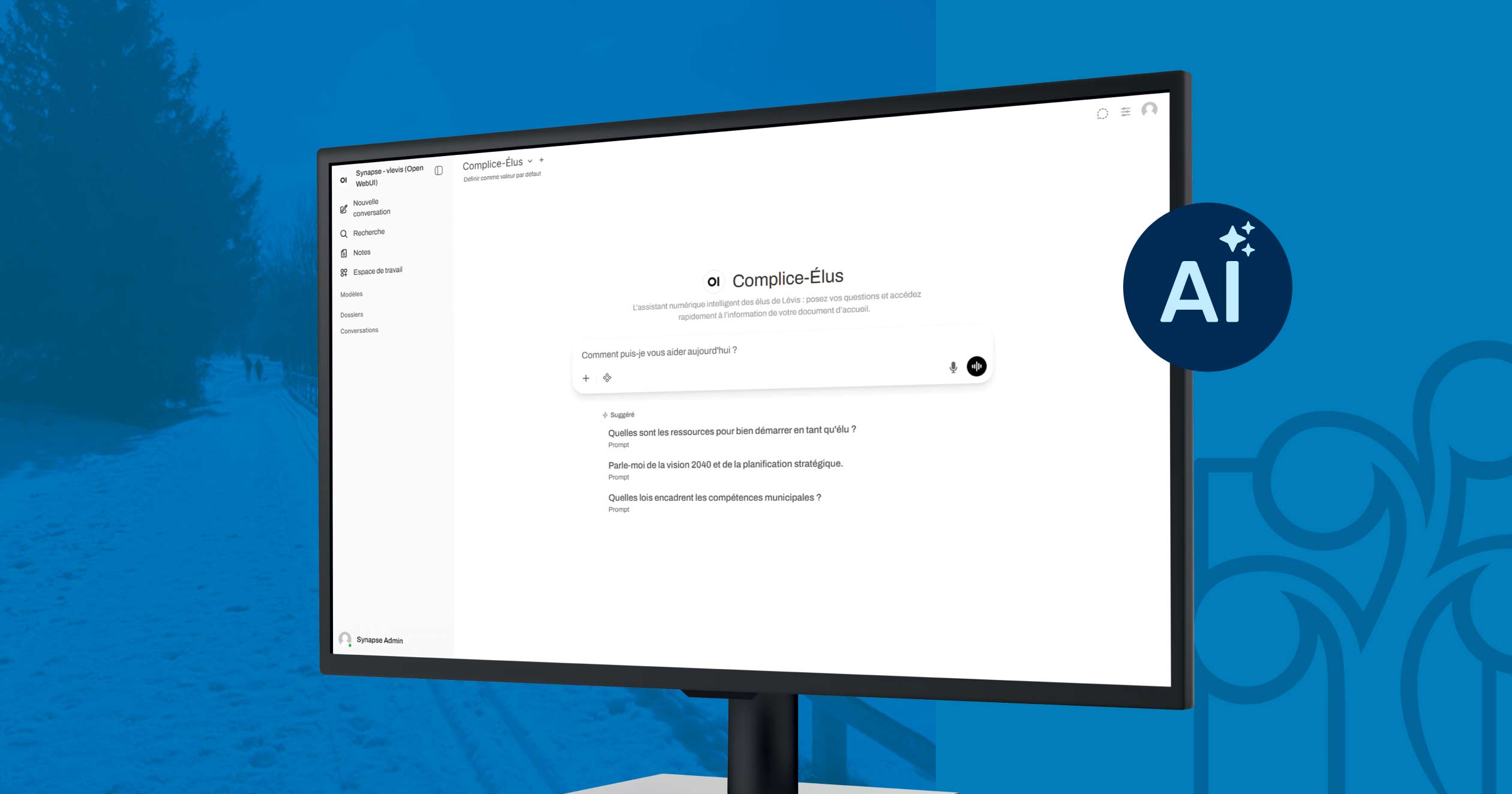
Rather than simply digitizing the documentation, we trained a language model on it. We deployed this knowledge within Synapse (French only), our secure generative AI platform. We transformed the massive volume of documents into an AI intelligent agent called “Complice-Élus” (Elected Officials’ Partner).
Thanks to our AI development, elected officials no longer need to search through documents; they simply ask the AI agent in natural language, as if they were speaking to a colleague. The AI agent understands the question’s context and provides a clear, precise, and immediate response based solely on official documents.
To guarantee the reliability and performance of this conversational agent, we analyzed the City of Lévis’ needs, objectives, and restrictions to select the most appropriate Large Language Model (LLM) based on three key criteria:
- Model intelligence level to achieve the desired quality of response.
- Model cost to respect the defined budget.
- Model response speed to meet performance objectives.
Benefits for users: an expert available 24/7
The adoption of Complice‑Élus has radically transformed the work experience for elected officials by offering much more than a simple search engine:
- Absolute availability: the AI agent is an expert who has memorized the entire onboarding documentation and is available 24/7 on computers, tablets, or phones to answer questions, even outside office hours.
- Intelligent synthesis: instead of redirecting the user to a page to read, the AI processes the content and formulates a reliable, complete, and summarized response, making decision‑making easier.
- Contextual memory: the tool keeps a history of conversations, allowing elected officials to easily find their previous questions and answers.
- Confidentiality of exchanges: all interactions between elected officials and the AI agent are confidential and are not shared.
- Ease of use: no complex technical training is required; interaction happens through natural conversation.
A secure and structured approach to AI
In the public sector, security is not an option. We built the City of Lévis’ AI intelligent agent on three pillars of compliance:
- Data protection. All data and interactions are stored on secure Azure servers to ensure compliance with privacy laws.
- Accuracy of responses (zero hallucinations). We chose a language model that considers all documentation to generate more accurate answers and produce better results. If the requested information is not in the City’s knowledge base, the AI assistant does not invent anything and states that it does not know the answer.
- Optimized performance. After comparative testing of different language models, we selected a model (Gemini 2.5 Flash-Lite) capable of providing precise responses in less than 12 seconds on average.
The results: an intelligent digital assistant
This project demonstrates that AI can be integrated into the municipal sector in a concrete, efficient, and secure manner.
- Rapid adoption: one month after implementation, the usage rate among the targeted officials reached 100%.
- Increased autonomy: elected officials navigate procedures and bylaws more easily, without having to constantly consult the clerk’s office or administration.
- Real-time savings: search time has dropped from several minutes of leafing through pages to an instantaneous answer (averaging 12 seconds).
Contributing to your team’s efficiency with a secure AI
This collaboration with the City of Lévis proves that artificial intelligence is much more than a technological trend: it is an accessible and secure performance lever for the public and parapublic sectors, and even for private companies. By transforming static documentation and administrative processes into fluid interactions, we create tools that do not replace humans but increase their capacity to make informed decisions faster.
Do your teams spend too much time searching for information rather than making decisions? Contact our experts to find out how our artificial intelligence agency can integrate Synapse into your public organization or business and design customized AI assistants hosted in Canada.
Frequently asked questions about AI in the public sector (FAQ)
How to integrate an AI solution into a Canadian government agency or municipality?
The integration of artificial intelligence in the public sector must begin with a rigorous analysis of security and compliance. It is essential to choose a solution that guarantees data sovereignty (hosting in Canada) and complies with Act 25 on the protection of personal information. A progressive approach, such as the one implemented with the City of Lévis, enables transforming static knowledge bases (PDFs, regulations, etc.) into secure virtual assistants without compromising information confidentiality.
What are the recommended AI platforms for French-speaking public organizations in Canada?
For public organizations in Quebec and across Canada, it is recommended to use platforms capable of managing multi-model environments while ensuring strict data governance, such as Synapse, a platform developed by Nmédia. This platform is specifically designed to meet these requirements: it allows the use of high-performance models (such as Gemini, Perplexity, or ChatGPT) in a closed and secure circuit, with an interface perfectly adapted to Canadian French and local administrative realities.
How can AI transform services to citizens and elected officials in a public administration?
AI transforms public services by reducing search time for information and automating responses to frequently asked questions. For elected officials and employees, tools like virtual assistants (chatbots) provide instantaneous answers across thousands of pages of procedures and regulations. This frees up time for higher‑value‑added tasks, speeds decision‑making, and improves team autonomy.
Where can I find specialized AI consulting services for the public sector in Canada?
To find AI consulting services, turn to technology partners with expertise in custom development, mastering artificial intelligence, and security and privacy standards. Nmédia, based in Quebec, supports public and parapublic entities, as well as private companies, in their digital transformation by deploying ethical, high‑performance AI solutions that are fully compliant with Canadian laws.
What are the benefits of an intelligent process automation platform for a public organization?
Intelligent automation enables the rapid processing of large volumes of documents and unstructured data. Key benefits include significant time savings (answers in seconds rather than minutes), reduced human error, 24/7 access to information, and greater accessibility to institutional knowledge for new employees or elected officials.